

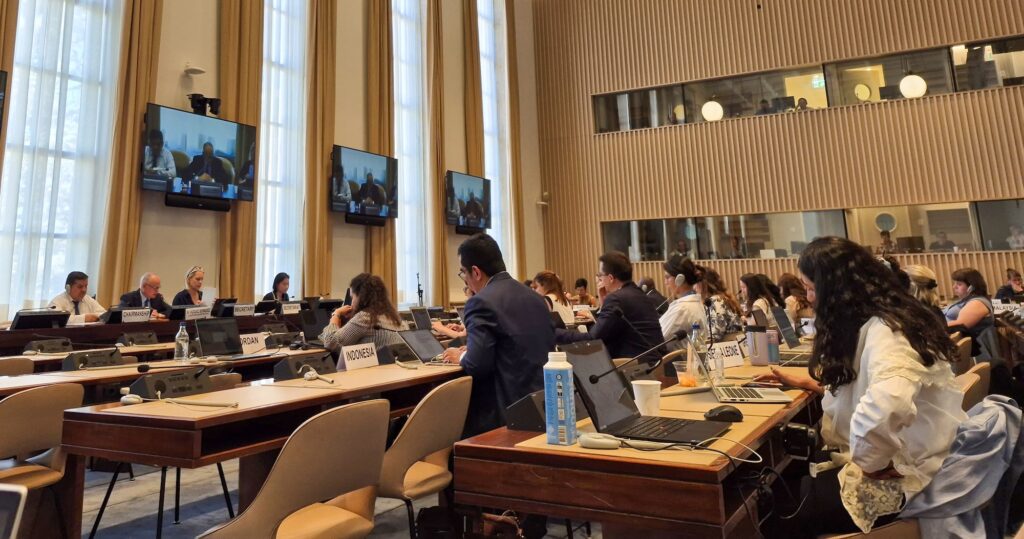
Franciscans International took part in a thematic consultation on 28 and 29 May, providing inputs on the draft text of a UN Treaty that would regulate business activities under international human rights law. This third and final intersessional meeting took place ahead of the 12th Session of the Open-Ended Intergovernmental Working Group (IGWG) on Transnational Corporations, where formal negotiations will continue in October. Bringing together diplomats, legal experts, and civil society representatives, the final consultation covered the preamble and Article 1 on definitions of the draft treaty.
Thirty-five UN Member States were present in the room, with their inputs highlighting divides that runs through these negotiations since they began in 2014. Some States, including Palestine, Colombia, and Mexico, are calling for stronger and broader language to uphold the rights of victims and affected communities. They also continue to stress the need for the treaty to apply to all business activities – rather than strictly those of a transnational nature – recognizing these as a leading cause of human rights violations today.
States in opposition to these progressive proposals, such as Japan, Saudi Arabia, and Russia propose a more restrictive reading on the articles. We noted with particular concern the backlash against including an explicit reference to the latest legal developments on the environment and climate, including the advisory opinion by the International Court of Justice, which underscores that all States have an obligation to combat climate change – this was affirmed by the UN General Assembly on 20 May. Business interests were also represented in the room and again attempted to dismiss the process as a whole.
FI continued its work with civil society partners and coalitions to push for stronger language related to the environment and conflict, particularly the applicability of international humanitarian law in relevant articles in the treaty. In many cases, these inputs were informed through grassroots connections: during previous sessions of the IGWG, FI has invited representatives of affected communities as a stark voice that existing, voluntary guidelines are woefully inadequate to prevent and remedy human rights violations caused by business activities.
The last part of the intersessional meetings focused on the way forward. The 2026 consultations will be summarized into a report containing textual proposals on selected articles as a basis for the 12th Session negotiations in October. The Chairperson will also publish a roadmap of work for 2027 in an ongoing and positive effort to move the negotiations forward.
After more than a decade of negotiations, there is a general perception that the process may come to an end in in 2027. However, while stronger, binding, safeguards on transnational corporations are urgently needed, FI and its partners will continue to stress that this process cannot end with a weakened instrument shaped by political compromise or corporate capture.
FI will again take an active part during the 12 Session of the IGWG, which will take place from 19 to 23 October 2026 in Geneva.