

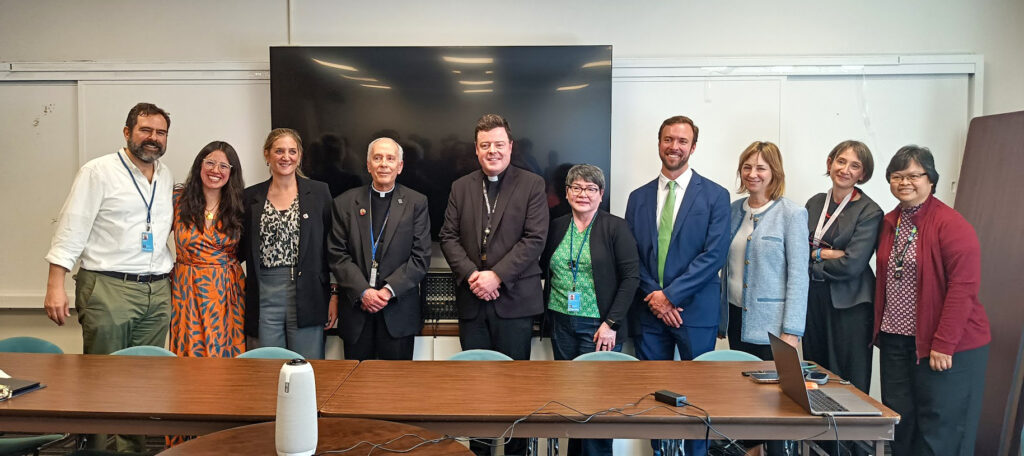
Together with Franciscans at the grassroots, we have made it our priority to fight for the rights of migrants around the world. That is why spaces like the International Migration Review Forum (IMRF), which examines and shapes international policies, are important to Franciscans International. We use these platforms to advocate for migrant rights, share firsthand experiences from the grassroots, and exchange perspectives with other activists and faith-based organizations.
In early May, we accompanied a group of Franciscans who attended the IMRF. Michele Dunne, a former U.S.-diplomat and the current Executive Director of the Franciscan Action Network (FAN), was among them. After visiting the UN in New York, she sat down with us for an interview where she gave us insight into her work, her personal journey with God, and shared her perspective on the political situation of the United States.
Thank you Michele, for taking your time! As the Executive Director of FAN, can you tell us a bit about your work and what your network is doing?
Of course! The Franciscan Action Network was founded in 2008 as an advocacy organization by Franciscans to provide a Franciscan voice on public issues in the United States (U.S.). We try to help Franciscans to mobilize around issues they care about, such as the environment, peace and the role of the U.S. in building it, as well as solidarity with marginalized people, including migrants or people who suffer from poverty.
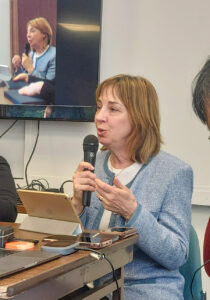
Before you started at FAN, you used to work as a diplomat for the US. Could you tell us a little bit about your work?
I was a diplomat for around 20 years. Since my work focused on the Middle East, I speak Arabic fluently. As an area specialist, I worked on issues such as the Israeli-Palestinian war and issues around the Arab Spring. After leaving the State Department, I worked for two think tanks, one of them the Carnegie Endowment for International Peace that helps countries and institutions to take on the most difficult global problems.
In 2013, I had a personal calling to join the Secular Franciscan Order, to which I professed in 2016. I had this strong calling to speak up much more about justice and peace inside the United States, and I became active in FAN as a constituent. In 2019, I went on a pilgrimage to Assisi, which had a profound effect on me. After that experience, I felt called to leave my diplomatic work behind and dedicate myself to the Franciscan Action Network, which I joined as executive director in 2021.
Franciscan Action Network
FAN includes 53 religious communities, 35 local Franciscan Justice Circles, and 20.000 individual members across the United States. Some of their core issues are the environment, solidarity with people on the margins, and peace. The latter encompasses both the role of the U.S regarding war and conflict around the world as well as peace inside the U.S, including gun violence and political polarization.
What do you think about migration politics right now? What is your perspective on migration politics in the U.S.?
Our migration policy is a disaster for both the world and the U.S. Americans cannot agree among ourselves on migration policies and have gradually reached a point where the system has broken down.
Now, we have disastrous deportation campaigns. People who have come to the U.S. suffer enormously. Most of them came with good intentions, wanting to contribute to society and the economy. This suffering pains me. Deportations and closing off migration will also definitely affect the U.S. economy. This is a top issue for policy advocacy in FAN.
During the IMRF, it was also painful to hear about other organizations affected by the U.S., including non-governmental organizations whose staff have had their visas denied, causing unneeded hardship.
What is your impression of the UN? Which difference is taking the space in such institutions in comparison with networks like yours?
Well, FAN’s advocacy is aimed at the U.S government and not the UN or the church. We aim at the Congress and the Executive Branch, including U.S agencies. Advocacy in the U.S. is very different compared to the UN, where you are looking at things from a very high-level perspective. Meanwhile, FAN is looking at things from a more bottom-up perspective, identifying which laws and practices need to change, such as limiting funding for ICE. When it comes to advocacy work, the focus is on respecting the safety and human dignity of migrants.
I learned a lot about international perspectives on U.S. migration policies during the review and I am eager to work more with FI to complement each other’s contributions. Already, we have done joint events with FI to show our constituents the global picture and how the U.S. is seen outside its own borders.
It was a pleasure to be a part of the delegation. Thank you for the invitation!