

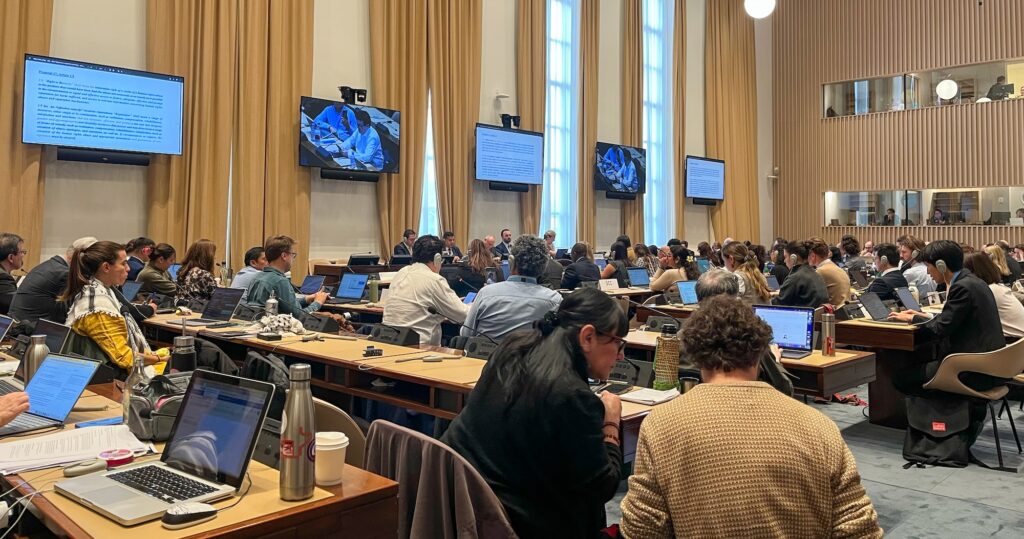
Franciscans International called for stronger environmental safeguards and protection for victims, as UN Member States continued negotiations toward a UN Treaty to regulate transnational corporations under international human rights law. With business activities as a leading cause of human rights violations, FI also stressed the urgency of strong action by the UN to reign in corporate impunity and resist the undue influence of businesses.
The 12th Session of the open-ended intergovernmental working group on transnational corporations and other business enterprises (IGWG) met in Geneva between 12 and 16 October, following a series of intersessional consultations. These laid the groundwork for proposals by the Chair on Articles 1 to 3 and Articles 12 and 24 of the proposed text. Throughout the week, over 60 UN Member States were present, with many actively commenting on the articles and considering areas of convergence. In doing so, they concluded a nearly 4-year long reading and negotiation of the third draft of this legally binding instrument.
Bringing grassroot voices to the negotiations
FI actively engaged in the session, providing its technical expertise through oral statements both independently and in close collaboration with partners and civil society networks. In order to examine the implications of and need for a new Treaty on affected communities and victims, FI participated and co-organized side events throughout the week. These included discussions on children’s’ rights, access to justice, accountability in global value chains, and the linkages between corporate accountability, conflict, and the right to a healthy environment.
Astrid Puentes Riaño, the UN Special Rapporteur on the right to a healthy environment, joined one of these events by video message to emphasize the need for an explicit reference to this right in the future Treaty. Her intervention was supported by other panelists who highlighted the impacts of businesses on human rights and the environment in varied contexts across the world. Mr. Terence Tshisevhe, First Secretary at the Permanent Mission of South Africa, also participated in the event and emphasized the need for protecting human rights defenders and for a strong binding treaty.
The road ahead
Throughout the week, FI worked closely as part of several civil society networks, including the Feminists for a Binding Treaty, ESCR-Net, and the Treaty Alliance. With these allies and other partners, FI coordinated statements, advocacy meetings with States, and plans for moving forward. As outlined by the Chair-Rapporteur, a new updated draft will be presented in February 2027. Based on the proposed roadmap by the Chair-Rapporteur, this will be followed by intersessional consultations ahead of the 13th session.
FI will continue to actively engage in the Treaty process in the year ahead, ensure that the voices of communities that it works with and who are directly affected by corporations are heard as the negotiations move forward.