

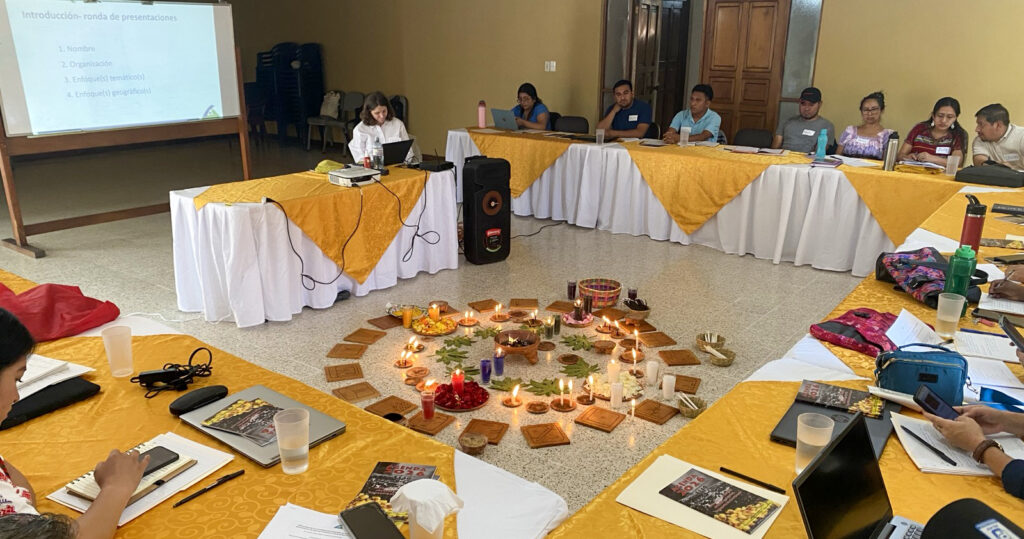
Franciscans International recently visited Guatemala to conduct a capacity building workshop for Franciscans and local civil society representatives. Through meetings with local partners, the mission also offered first-hand insights into the escalating challenges faced by human rights defenders and Indigenous communities – dynamics that cannot be captured through remote monitoring alone.
Parallel to this training, FI also met with the Guatemala team of the Franciscan Network for Migrants (RFM), whose members provide direct humanitarian assistance to people on the move. These include a growing number of returning migrants following deportation or because of increasingly restrictive migration policies in the United States.
Guatemala continues to face a broad range of structural human rights challenges. Despite the election of a reform-oriented administration in 2023, there is an ongoing deterioration of the rule of law combined with institutional fragility that limits access to justice for affected communities. In a context where powerful corporations threaten Indigenous lands, human rights defenders have borne the brunt of a judiciary that has been co-opted by special interests through criminalization, intimidation, and reprisals. Added to this are complex migration dynamics, including an increasing number of returnees that heighten social-economic pressures in the country.
A key priority of the visit was strengthening coordination, cooperation, and capacity of civil society organizations and the national and international level to expose human rights violations when domestic avenues fall short. As part of the workshop, FI provided the first steps toward initiating a documenting process that can serve to more effectively raise human rights violations with UN Special Procedures and other relevant UN mechanisms.
Meanwhile, the RFM further empathized the changing migration dynamics in the region that FI has previously raised at the UN Human Rights Council. The situation has become increasingly more complex, with a growing number of returnees requiring support and heightening socio-economic pressure in this country. In this context, FI will continue both to raise human rights violations documented by the RFM at the UN and work to strengthen the network’s capacity do so throughout the Americas.
As a first step following the visit, FI is preparing a submission to the UN Working Group on Business and Human Rights, which will visit Guatemala later this year. The report will reflect the community-rooted evidence gathered during the workshop, including concerns around conflicts about land and natural resources, the lack of consultation with affected communities, and environmental harms linked to business activities.