

Women and girls continue to be at disproportionate risk of a range of human rights violations. Franciscans International raised multiple such cases during the 70th session of the UN Commission on the Status of Women (CSW), which was held from 9 to 19 March 2026 in New York. This year’s session focused on access to justice, including through promoting inclusive and equitable legal systems, eliminating discriminatory laws, policies, and practices, and addressing structural barriers. On the first day of the session, Agreed Conclusions were adopted that outlined measures for States to take. Breaking with tradition, these were adopted by vote rather than by consensus at the behest of the United States.
FI, alongside partners, worked to underscore issues related to access to justice for human rights violations during the two weeks . As part of the NGO Mining Working Group, FI helped to organize the online parallel event, “Generating Justice: Genocide, Ecocide, and Gender Justice” on 16 March 2026. The event underscored the high risks of environmental degradation and human rights abuses posed by the extractives sector, and the disproportionate impacts often born by women. Corporations, working alongside and on behalf of States, often operate with impunity, enabling the continuation of abuses.
The event opened with Fiji’s Permanent Secretary of Environment and Climate Change, Dr. Sivendra Michael, emphasizing the importance of a robust Plastics Pollution Treaty that deals with the full life-cycle of plastics. Fiji, a co-sponsor of the event, has been a leader in environmental and climate justice and has proposed an amendment to the Rome Statute of the International Criminal Court (ICC) on the inclusion of the crime of ecocide together with Vanuatu and Samoa in 2024. Other speakers raised cases in West Papua, the United States, Myanmar, and Gaza to highlight the interconnection between extractivism, ecocide, and genocide.
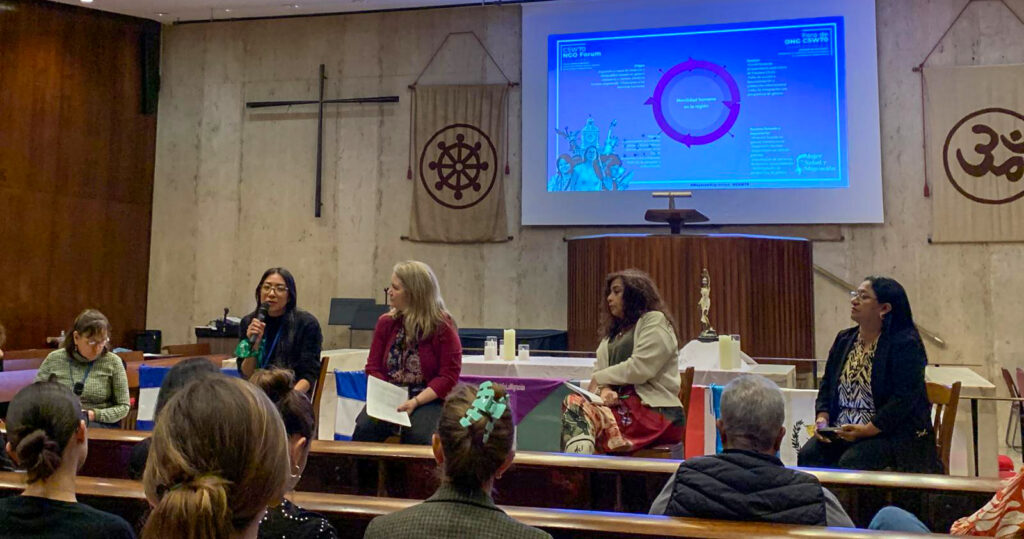
On 16 March, FI and the Franciscan Network for Migrants also co-sponsored a second event organized by Mesoamerican Women, Health, and Migration Network (RMMSyM) examining violence against women on the move in Mesoamerica.” The event explored strategies towards guaranteeing access to justice and to address, eradicate, and prevent gender-based violence within the context of human mobility in El Salvador, Guatemala, Honduras, and Mexico. The discussion also underscored how multiple and intersecting forms of discrimination obstruct women’s access to justice.
Alongside these formal events, FI also participated in a silent vigil for Palestine with other groups.
Finally, on 17 March, the NGO Mining Working Group delivered an oral intervention, supported by FI. The statement highlighted various issues that we have documented across different contexts regarding the adverse impacts of extractive activities. As noted in the statement, “women must walk longer distances to access clean water, contend with dust-covered crops, and risk subjection to gender-based violence. Land dispossession, forced eviction, and forced labor undermine women’s capacity to provide for themselves and their families. Women environmental and human rights defenders confronting mining activity face retaliation, intimidation, sexual harassment, and even rape and death.”
Across the world, we see impunity, rather than accountability, prevail – an unacceptable norm.